Amidst the Canadian law firms and regulated Canadian immigration consultants who understand and can advise you on Canadian immigration matters, there are also endless travel agencies and foreign companies offering immigration services, including faceless, nameless websites offering their services in Canadian immigration without revealing who is going to prepare the application.

Foreign lawyers can be legitimately practicing law in their native country, but they are not permitted to practice Canadian immigration law as per the Immigration and Refugee Protection Act (IRPA); the same applies to travel agencies or any other entity or individual who has no official authorization to represent you regarding Canadian immigration law.

Risks of being represented by unlicensed professionals

Being represented by unlicensed professionals comes with many risks.  One of the most problematic is misrepresentation; these unprofessional companies like to take shortcuts and distort or conceal the facts, which may lead to misrepresentation, and thus a 5-year bar for you, the applicant, as the applicant is the one responsible for mistakes on his or her application.

Rules aren’t the only thing they have limited regard for, either. They just fill out the forms, but they do not advocate for your benefit; they submit your application on your behalf as if it is you who is submitting. Their lack of a proper understanding of Canadian immigration laws and guidelines also means that any advice or assistance they do give you may not be trustworthy. They don’t know enough to tell you what you should do. Do these travel agencies and nameless companies really advocate on your behalf?

Who makes the misrepresentation and when?

The applicant is, of course, ultimately responsible for his or her own misrepresentations.   If a procedural fairness letter was sent to what is allegedly your email address (but is actually an email created by your unlicensed representative — let’s say your travel agency), and that letter never reaches you, thereby making you unable to rebut the concerns that an immigration officer may have, it would not be legally defensible that you didn’t know that a travel agency is not permitted to represent you.  As a result, you would be barred for 5 years.

Also, you must disclose if you have received assistance in preparing your application from a person who is compensated or receives a benefit as a result of such assistance. Failure to declare such assistance may result in the refusal of the application or you may be found inadmissible to Canada, as you have not disclosed this fact. If you pay someone to act as your representative, they must meet the requirements for authorized representatives, as listed below.  “Ghost consultants” have no knowledge on how to address the issues that immigration officers might have raised.  The result? Refusal of your application, or worse — a 5-year bar.  Is it worth risking your future?

So who can represent you?

Only Canadian lawyers in good standing with their respectful law society, regulated Canadian immigration consultants (RCICs), and Quebec notaries are eligible to assist in immigrating to Canada for payment (direct or indirect).

Because of the issues with unauthorized representatives, Bill C-35, An Act to Amend the Immigration and Refugee Protection Act (IRPA), came into force on June 30, 2011. The bill created a new offence by extending the prohibition against representing or advising (or offering to represent or advise) immigration applicants or potential applicants to include all stages connected to an application or proceeding, including those prior to the official application being made, and puts penalties in place for those who violate this ruling.  And by using the services of someone who isn’t authorized, you, the applicant, might be found to have misrepresented yourself on your application, as you did not disclose that you retained and paid for the services of an organization or an individual that does not fall under one of the three categories permitted to represent for a fee.

The Immigration Consultants of Canada Regulatory Council (“ICCRC”) is responsible for regulating the activities of the immigration consultants who are its members and who provide immigration advice and representation. ICCRC operates at arm’s length from the Government of Canada. Membership is granted only to those individuals who have demonstrated their knowledge and ability to advise and represent people who seek to immigrate to Canada.

Always check if your representative is a licenced Canadian immigration consultant. The risks to your future are too great otherwise. The representatives at Milmantas Immigration are all members of ICCRC, and we are here to help if you need assistance with a Canadian immigration matter.  If you need help handling an immigration application, contact us

Share this entry

Moving to Canada temporarily or permanently as a US citizen

Americans considering moving to Canada can explore immigration options such as Express Entry, work permits, or studying. Learn more about pathways to permanent residency with Milmantas Immigration.

Resume from concept.Hand of man holding resume review to applying for job.

Your Resume for Canadian Immigration Purposes

I am writing this blog as I consistently encounter this issue in my practice, and it became clear that prospective temporary permanent applicants need some assistance.

Today, I will discuss how your resume should be prepared for Canadian immigration purposes, as the Canadian resume format is different.  It is imperative that your resume is prepared, having in mind that it will be read by an immigration officer.  Your resume may be included in submitting your application for a:

  1. Study permit
  2. Work permit, and/or
  3. Permanent resident application, an example, an OINP application

For immigration purposes, a chronological format is the best. After you immigrate to Canada, you will need to amend it again for the Canadian labour market, which has different requirements, as you will need to meet employers’ and recruiters’ needs.

The recruitment industry has changed enormously with the digital age. What worked in the past can be professionally fatal today, as recruiters don’t read resumes anymore—they scan.

The result?               You have only 20 seconds to impress the recruiter.

Yes, you might be the best candidate with great qualifications, but if your CV does not communicate that at a glance, you’re done.  It is your job to SHOW IMMEDIATELY that you are the ideal candidate.  That FIRST IMPRESSION is the most important part of a resume; therefore, you will need to research how to effectively prepare your resume at that time.

For now, I would like to assist you in preparing your resume for your immigration-related applications.  Your resume will be read by an immigration officer in charge of your file. Therefore, it needs to meet the immigration requirements.

Every country has different requirements, and a resume prepared for countries in the European Union, or, for an Indian market, most likely will not meet the requirements for Canadian immigration, as immigration officers will be looking for specific information related to your immigration file.

If you’re applying for a specific immigration program, you may also want to check if your resume fits the criteria of the program, in the first place. There are specific rules about which jobs are considered skilled trades or skilled workers. Also, if the job fits the criteria, keep those criteria in mind when writing the descriptions of your past work experience—just make sure that the duties and skills you mention in your description are accurate to the positions you have held. Also, you should review and cross-reference your duties and responsibilities with the corresponding NOC code.

Please also bear in mind that your resume, included in your immigration application, should coincide with your social media accounts, such as Instagram and LinkedIn, as immigration offices DO cross-reference your resume with your social media accounts.

For your ease of reference, attached please find a template of a chronological resume.  I trust that these observations and the template will be of assistance to you.

If you intend to come to Canada as a worker, a student or a permanent immigrant and need assistance in submitting your application, please contact us.

Click Here to Download the Resume Template

Dictionary definition of word

Translation of documents for immigration to Canada: Part 2

This is a continuation of Translation of documents for immigration to Canada: Part 1


Unacceptable affidavits and declarations


Accuracy of translated documents

Should the accuracy of the translation appear suspicious, IRCC reserves the right to request a retranslation by a different translator. However, due to the poor accuracy of a translated document, the entire file might lose credibility. Therefore, the counsel should read all the translations and request the translation to be amended, or use the services of another translator.

Based on my experience, it is highly recommended that documents be translated by translators living in Canada, except ID documents such as birth or marriage certificates.

Expiry of translated documents

A translation should be valid indefinitely unless the source document has changed or has expired. The only time the translation would expire and a new translation would be required is if the original document has expired or changed and the applicant submits a new one.

Applications submitted without translations

Applicants who submit required documents without accompanying translations will have their application returned as incomplete or refused, as immigration officers are not obligated to consider documents written in a language other than the state languages of Canada – English or French.

This fact is illustrated in 2017 FC 1105 (CanLII) I Gonzalez Zuluaga v. Canada (Citizenship and Immigration), wherein the Honourable Mr. Justice Martineau indicated that

[ 11] …the officer was entitled not to consider the property titles written in Spanish. In fact, the super visa application guide clearly indicates that documents in a foreign language must be translated into one of Canada’s official languages.

The Case of Hasan Gorgulu and lessons to be learned

The case of Hasan Gorgulu is a worthwhile example of why it is important to ensure the absolute accuracy of the translation of foreign documents.  Mr. Gorgulu’s case was brought before Federal Courts in January 2023. Gorgulu, a citizen of Turkey, applied for a pre-removal risk assessment (PRRA) to IRCC. However, although he provided copies of these documents translated into English, they were not certified.  Therefore, Gorgulu’s application was refused because the IRCC officer stated that the English documents were not “certified to be accurate by the translator”.

Any documents submitted in a non-official language must be accompanied by an official language translation, complete with a translator’s declaration. The Guide also states that documents submitted only in non-official languages will not be considered, as the federal court states that IRCC personnel cannot be required to understand documents written in non-official languages, because IRCC personnel will not be able to assess the information in the document written in a foreign language, and after all the state languages of Canada are English and French.

Another interesting case to read is Wang v. Canada (Minister of Citizenship and Immigration), 1999 CanLII 8576 (FC).

Failing to provide a complete, accurate and certified translation of foreign-language documents into English or French can have dire consequences for an immigration application.

The final confusing issue is between “a certified or notarized document” and “a certified translation.”

A certified or a notarized document means that a notary public states this is a true copy of the original document.

A certified translation means that the translation is done by a professional translator, not a person himself.

I trust that the presented aspects will allow you to avoid having your documents translated several times and spare you from frustration, stress and waste of time and money when preparing a Canadian immigration application.  Always make sure to hire the right translator.

If you have any questions or need further clarification regarding your application, don’t hesitate to book an online consultation.

Learning foreign languages online. Headphones and countries flags on the background.

Translation of documents for immigration to Canada: Part 1

Individuals submitting their applications for immigration to Canada must ensure that all supporting documents issued in a language other than English or French are accompanied by an official translation, regardless of your immigration category, be it a temporary or permanent resident application.

This also applies to multilingual documents containing text in English and/or French, such as the European Criminal Record Check, ID cards, driver’s licence, etc.. wherein just several or even one single word is in another language, as it might be an officer’s discretion to return or refuse your application.

IRCC does not accept translations done by you, the applicant, family members, or your legal representative, be it a consultant, a lawyer, or a notary, regardless, your representative may be a certified translator.

Documents written in a foreign language must be:

  1. translated by a certified translator and
  2. accompanied by an affidavit or a declaration signed by a translator and/or stamped by the translator who translated the document

Please note that some provincial nominee programs may have their specific translator’s affidavits, and therefore, you need to ensure that the translation meets these specific requirements.

If documents are translated in Canada

Applicants should use the services of a certified translator who is in good standing with their provincial or territorial organization. The translator’s certification can be confirmed by a seal or stamp that shows the translator’s membership number of the association. In Ontario, such an association is called the Association of Translators and Interpreters of Ontario (ATIO). Every province has its own professional translation association.

Documents translated by a non-certified translator

Whether the translation was conducted by a certified translator or in situations where the translation cannot be provided by a certified translator, for languages such as Lithuanian, Latvian, Estonian and other nations with a very small population in Canada, in either case, the translation must be accompanied by an affidavit/declaration wherein the translator swears to the accuracy of the translation.

SOMETIMES, the translator is required to swear that the translation is a true rendition of the source document in front of a commissioner authorized to administer oaths.

Who can swear an affidavit?

In Canada:

  • a notary public
  • a commissioner of oaths
  • a commissioner of taking affidavits

Outside Canada:

  • a notary public, or equivalent

Translations done outside Canada.

Each country may have different requirements for the translation of documents. Therefore, the translations need to meet the requirements of that country. Regardless, it MUST be accompanied by a translator’s affidavit or a declaration.

Continue to Part 2 »

Rippled textile flag of Canada close up

About Canada

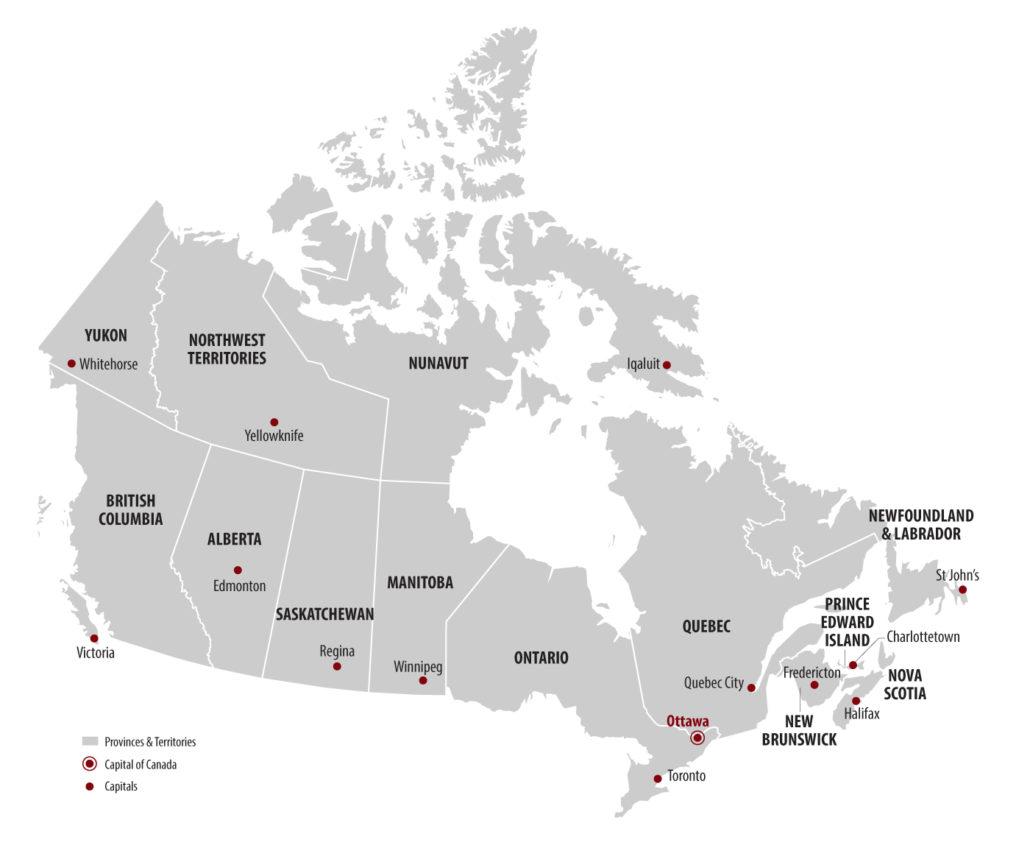
Canada is a federation composed of ten provinces and three territories, which may be grouped into regions: Western Canada, Central Canada, Atlantic Canada, and Northern Canada (the latter consists of the three territories Yukon, Northwest Territories, and Nunavut).

Provinces have more autonomy than territories and each has its own provincial or territorial symbols. The provinces are responsible for most of Canada’s social programs: health care, education, and welfare.

Provinces & Territories

www.hellobc.com – British Columbia
www.travelalberta.com – Alberta
www.sasktourism.com – Saskatchewan
www.gov.mb.ca – Manitoba
www.ontariotravel.net – Ontario
www.bonjourquebec.com – Quebec
www.tourismnewbrunswick.ca – New Brunswick
www.novascotia.com – Nova Scotia
www.tourismpei.com –Prince Edward Island
www.explorenewfoundlandandlabrador.com – Newfoundland and Labrador
www.nwt.worldweb.com – North-West Territories
www.nunavuttourism.com – Nunavut
www.travelyukon.com – Yukon Territory

We trust that learning about Canada’s diverse provinces and territories will help you make an informed decision and that you’ll soon find the perfect place to call home.

Inscription fraud

About Fraud

Beware of Immigration Fraud!

You’ve decided that you want to immigrate to Canada to make a better life for yourself and your family. During a consultation, you discover that you do not have enough points, and in order to obtain a higher score so you can immigrate to Canada under the Express Entry system, a Labour Market Impact Assessment (LMIA) is required.

An LMIA is initiated by a Canadian employer from within Canada and is issued by Service Canada. In addition to your Express Entry application, an LMIA is also often necessary for a work permit. The employer needs to prove to the Canadian government that the company is unable to locate a Canadian permanent resident or citizen to fill the position. It is a complicated, lengthy and fairly costly process that companies often do not wish to go through, as the employer is required to provide financial documents to Service Canada, pay the required salary, advertise for one month in accordance with the requirements established by the government, and submit an application for the LMIA to Service Canada. The employer will also most likely be interviewed by Service Canada to ensure that the job offer is genuine. Because of all these challenges, some employers are reluctant to go through the process and instead try to meet their employment needs within Canada.

And that is when unassuming and trusting individuals may get ripped off by those selling fake LMIAs. This happens in various countries where companies are involved in the immigration business but are not licenced, acting instead as unauthorized “ghost” consulting firms. Be vigilant. Protect your investment, your savings and your future from bogus promises and fraudulent individuals. Fraud is a criminal offence in Canada.

Identity theft is another form of fraud to watch out for. Once you’re in Canada, criminals involved in identity theft may pose as immigration officers. They may call you and require you to meet them, threatening that you will be deported if you refuse to meet with them and pay them money. They usually schedule their meetings close to immigration centers. Don’t be scared. Protect yourself and call the police, and refrain from engaging in further conversation.

Be cautious about immigration services with suspiciously low prices. Fees that are much lower than the market rate and easy-entry programs are attractive, but if it sounds too good to be true, it most likely is. They may be selling you services for an immigration program that doesn’t exist! In addition to fake LMIAs, be on the alert for other false documents, such as visas for made-up programs.

Do not be deceived by advertisements that quote very low fees. You need to question what kind of service such a company is going to provide for so little money. Properly preparing an application for a client requires professional knowledge and time. Individuals that charge low fees are usually not authorized to represent you to IRCC, and the low fees are just there for them to make some quick, easy money.

There’s no need to take our word for it. A little research will bring up real-life cases where would-be immigrants have become victims of fraudsters.

Don’t be the victim of a scam; contact a licensed immigration professional. We’re here to help with your LMIA, work permit and permanent residence, and we’ll do it the right way!

Language Assessment

Planning to Immigrate to Canada?

One of the mandatory requirements under the Express Entry management system is the results of the language test, conducted by a designated language-testing agency approved by Immigration, Refugees and Citizenship Canada (IRCC). There are three IRCC-approved language test facilitators: CELPIP and IELTS for English, and TEF and TCF for French.

It has been established that knowledge of one of the official languages of Canada plays a major role in the economic and social success and integration of immigrants to Canada.

Therefore, IRCC has made it mandatory that applicants to most immigration categories meet the minimum language requirements.  Language tests are also mandatory for applicants whose native language is English or French, as the test score results are the only way to allocate language points to the applicant.  Your language test results must be less than two years old on the day they are received by IRCC.

Language Requirements for Different Immigration Programs

The language requirements are different depending on which immigration program you are applying for, as the language skills you’ll need will differ depending on whether you are hoping to immigrate to Canada as a skilled professional, a tradesman, as a business person, or through a provincial nominee program.

An applicant needs to achieve the required score in every ability: reading, writing, listening and speaking, as an overall score is not enough for immigration purposes. If an applicant lacks 0.5 of a point in one ability, then it means that the applicant is not eligible and thus needs to improve their language skills.

Should I Choose IELTS or CELPIP? 

Your choice depends upon the availability of testing centers in your country.

IELTS has testing centers located in over 140 countries, while CELPIP has test centers at multiple locations across Canada, test sittings in Dubai, UAE, and New York, USA.  Please register as early as possible to avoid lengthy waiting times.

The Cost of Taking a Test

The fee may be about $300.00CAD per test; fees should be clarified with the specific test center where you intend to take the test.

Both facilitators offer free sample tests, upon completion of which you will be able to decide if you should register for a preparation course. The higher the score, the more points you will gain under the Comprehensive Ranking System under Express Entry. Because of this, you may find that you want to improve your language skills even if the practice tests show that you will probably pass.

English Language Test

CELPIP — Canadian English Language Proficiency Index Program — www.celpiptest.ca

You must take the “CELPIP-General” test to support your immigration application.

IELTS — International English Language Testing System —www.ielts.org

IELTS has test centers all over the globe.  You must take the “General Training” test.

French Language Test

TEF — Test d’évaluation de français  — www.francais.cci-paris-idf.fr

TEF is only available in French.

You must submit results from these TEF tests as proof of your French language skills:

  1. TCF Canada: Test de connaissance du français, including: https://www.ciep.fr/tcf-canada
  2. compréhension de l’écrit
  3. compréhension de l’oral
  4. expression écrite
  5. expression orale

Language Test for Students

Applicants planning to study in Canada are also required to meet the language requirements to successfully study at Canadian educational institutions.  Potential students from countries where English is not the primary language of instruction are required to provide an English language proficiency examination test result.  As a rule, tests must have been taken within the last 24 months at the time of the submission of your application.

A minimum overall band score of 6.5 is usually required for the academic (NOT general) IELTS test.  Some universities require an overall score of 7.0. Therefore, you will need to contact the educational institution of your choice in order to clarify the language requirements.

If you intend to study English or French as a Second Language, preliminary test results may not be required, as you will be required to take a  test later to be placed in a group at your level.

Be prepared so that the best language test results can bring you closer to your dreams in Canada.

Which province do you want to immigrate to?

Canada is a federation composed of ten provinces and three territories, which may be grouped into regions: Western Canada, Central Canada, Atlantic Canada, and Northern Canada (the latter consists of the three territories Yukon, Northwest Territories, and Nunavut).

Provinces have more autonomy than territories and each has its own provincial or territorial symbols. The provinces are responsible for most of Canada’s social programs: health care, education, and welfare.

Provinces & Territories

www.hellobc.com – British Columbia
www.travelalberta.com – Alberta
www.sasktourism.com – Saskatchewan
www.gov.mb.ca – Manitoba
www.ontariotravel.net – Ontario
www.bonjourquebec.com – Quebec
www.tourismnewbrunswick.ca – New Brunswick
www.novascotia.com – Nova Scotia
www.tourismpei.com –Prince Edward Island
www.explorenewfoundlandandlabrador.com – Newfoundland and Labrador
www.nwt.worldweb.com – North-West Territories
www.nunavuttourism.com – Nunavut
www.travelyukon.com – Yukon Territory

language-for-immigration

I want to immigrate to Canada, do I need to know English? I want to study in Canada, do I still need to know English?

Planning to Immigrate to Canada?

One of the mandatory requirements under the Express Entry management system is the results of the language test, conducted by a designated language-testing agency approved by Immigration, Refugees and Citizenship Canada (IRCC). There are three IRCC-approved language test facilitators: CELPIP and IELTS for English, and TEF and TCF for French.

It has been established that knowledge of one of the official languages of Canada plays a major role in the economic and social success and integration of immigrants to Canada.

Therefore, IRCC has made it mandatory that applicants to most immigration categories meet the minimum language requirements.  Language tests are also mandatory for applicants whose native language is English or French, as the test score results are the only way to allocate language points to the applicant.  Your language test results must be less than two years old on the day they are received by IRCC.

Language Requirements for Different Immigration Programs

The language requirements are different depending on which immigration program you are applying for, as the language skills you’ll need will differ depending on whether you are hoping to immigrate to Canada as a skilled professional, a tradesman, as a business person, or through a provincial nominee program.

An applicant needs to achieve the required score in every ability: reading, writing, listening and speaking, as an overall score is not enough for immigration purposes. If an applicant lacks 0.5 of a point in one ability, then it means that the applicant is not eligible and thus needs to improve their language skills.

Should I Choose IELTS or CELPIP?

Your choice depends upon the availability of testing centers in your country.

IELTS has testing centers located in over 140 countries, while CELPIP has test centers at multiple locations across Canada, test sittings in Dubai, UAE, and New York, USA.  Please register as early as possible to avoid lengthy waiting times.

The Cost of Taking a Test

The fee may be about $300.00CAD per test; fees should be clarified with the specific test center where you intend to take the test.

Both facilitators offer free sample tests, upon completion of which you will be able to decide if you should register for a preparation course. The higher the score, the more points you will gain under the Comprehensive Ranking System under Express Entry. Because of this, you may find that you want to improve your language skills even if the practice tests show that you will probably pass.

English Language Test

CELPIP — Canadian English Language Proficiency Index Program — www.celpiptest.ca

You must take the “CELPIP-General” test to support your immigration application.

IELTS — International English Language Testing System —www.ielts.org

IELTS has test centers all over the globe.  You must take the “General Training” test.

French Language Test

TEF — Test d’évaluation de français  — www.francais.cci-paris-idf.fr

TEF is only available in French.

You must submit results from these TEF tests as proof of your French language skills:

  1. TCF Canada: Test de connaissance du français, including: https://www.ciep.fr/tcf-canada
  2. compréhension de l’écrit
  3. compréhension de l’oral
  4. expression écrite
  5. expression orale

Language Test for Students

Applicants planning to study in Canada are also required to meet the language requirements to successfully study at Canadian educational institutions.  Potential students from countries where English is not the primary language of instruction are required to provide an English language proficiency examination test result.  As a rule, tests must have been taken within the last 24 months at the time of the submission of your application.

A minimum overall band score of 6.5 is usually required for the academic (NOT general) IELTS test.  Some universities require an overall score of 7.0. Therefore, you will need to contact the educational institution of your choice in order to clarify the language requirements.

If you intend to study English or French as a Second Language, preliminary test results may not be required, as you will be required to take a test later to be placed in a group at your level.

Be prepared so that the best language test results can bring you closer to your dreams in Canada.

Avoid a Refusal

Often, we wonder why is it that we need professional help to do something we can do ourselves? I will simply follow the instruction manual and complete the task myself. After all, the instruction manual is provided for a reason.

While in most circumstances you can execute your own DIY project to desired results (while saving a few bucks), yet what if you were told that your future depended on it and you only get 1 chance to do it right? What would you do then? Consider the fact that the risk isn’t just about the effort or time you put into it, a negative outcome will lead to a financial loss along with a lost opportunity you only had one chance to grab.

Immigration Applications

Immigration applications are one such scenario. Yes, you do get an instruction guide and most of the times you may hit the nail on the head, but even a tiny error could result in extensive delays or in more critical scenarios – a long term ban.

As the saying goes, there’s more to it than meets the eye; similarly, in matters concerning immigration to Canada, many issues that an immigration officer may consider when making a decision aren’t addressed in the guide or checklist at all.

The fact that most people do not know is that an immigration officer would rather rely on guidelines set out in the Program Delivery Instructions, than the instruction guide available on the web.

Consider this – have you ever received or known someone who has received a visa refusal stating – ‘’lack of ties to country of origin’’, even when the applicant shared details of ownership of multiple properties, financial holdings, business undertakings of not just themselves but their entire families? Or how about – lack of employment prospects in their home country” despite them submitting official letters from their current employers stating that their positions will be held for them while they studied.

Mistakes Happen

The recent episode of the work permit refusal of Steve and Melanie Whitlow is proof enough that even the slightest error could open doors to significant delays, refusals and the painstaking immigration appeals process.

In a recent scenario, Steve and Melanie Whitlow, moved to B.C. from Wisconsin as part of B.C.’s PNP. While applying for an extension to their work permits, they failed to include the necessary Labour Market Impact Assessment (LMIA) exemption number from her employer. A small error, a mere oversight as she states. But it led to denial of their extension.

Such errors, although minor, yet unnoticeable to the untrained eye could be the make or break factor for your Canadian immigration application.

As a result, they lost half of their combined income because, the husband became ineligible to work in Canada legally. Although, the wife was able to appeal and get her permit re-instated, the husband’s case is still pending review. Thus, the cumulative stress and loss of income is far more than the RCIC’s professional fee.

These issues aren’t limited to study permits or work permits. Applicants are always at a disadvantage when dealing with Canadian Immigration on their own, because the power and knowledge are both in the hands of the government, and the officer reviewing an application has far less to gain or lose than the applicant. The immigration officer is part of the system that the applicant is trying to work with and therefore knows how to navigate the system, while the applicant is a newcomer to the maze of Immigration forms and lists.

Seek Representation

One way to help level the playing field is to seek representation. A regulated Canadian immigration consultant (RCIC) can provide legal knowledge and support through this difficult process, making dealing with Canadian Immigration less stressful and helping to improve the chances of success. With many years of experience, we know what to anticipate from Immigration officials, and we build your case based on its individual merits, going beyond the checklist provided by Immigration in order to successfully advocate on your behalf.

If you’re intending to come to Canada as a worker, a student or are planning to permanently immigrate to Canada and need help submitting an application, contact us.