
Blurry Documents Get No Second Chances: Federal Court Upholds Refusal Over Illegible Files
Is a quick phone photo really “good enough” for your immigration application? According to a recent Federal Court decision, Majid v. Canada (Citizenship and Immigration), the answer is a firm no. The ruling is a wake-up call for anyone submitting documents online, and it applies to every application type, not just work permit application.
Here’s how a high-stakes spousal work permit application was refused over nothing more than illegible files, and what it means for your own submission.
The Core Issue: Illegible Documents
The applicant, Mr. Majid, applied for an open work permit as an accompanying spouse to join his wife, who was already working in Canada.
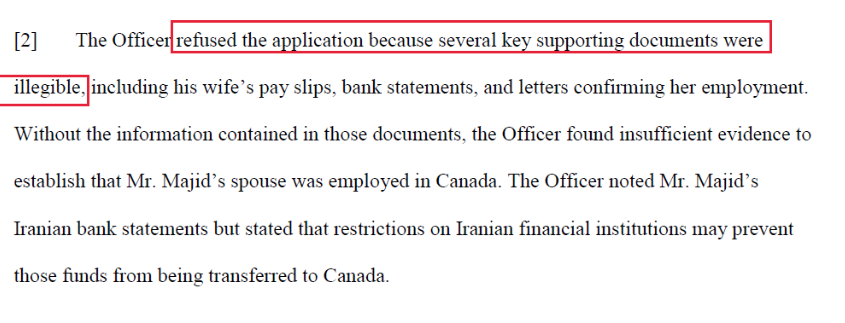
An IRCC officer refused the application for one simple reason: key supporting documents, including his wife’s pay slips, bank statements, and employment letter, were blurry and unreadable. Since the officer couldn’t make out the details, there was no way to confirm his wife was genuinely employed in Canada. Insufficient proof meant a refusal.
The Legal Battle: Was It Fair to Refuse Over Blurry Scans?
Mr. Majid took the case to the Federal Court, arguing two main points:
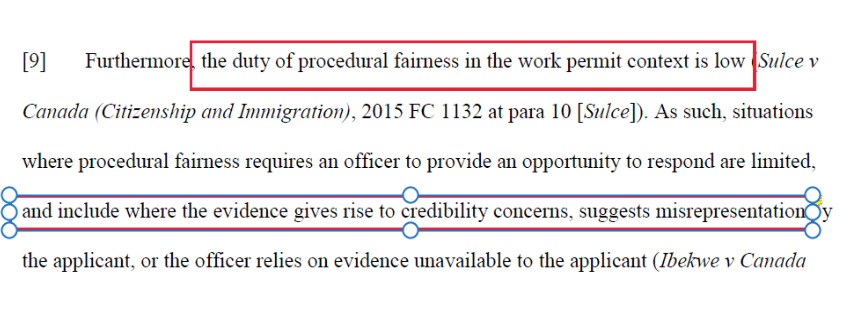
Give me a second chance. He argued it was procedurally unfair for the officer to refuse the application outright without giving him a chance to submit clearer copies.
Blame the portal. He suggested IRCC’s own online portal may have compressed or degraded the image quality during upload, making the files blurry through no fault of his own.
Why the Federal Court Upheld the Refusal
Justice Ann Marie McDonald dismissed the application, reinforcing two core principles of Canadian immigration law.
- Your upload, your responsibility. The Court confirmed that the burden rests entirely on the applicant to submit a complete, legible application from the start. Officers are under no legal obligation to request better-quality copies when the original submission simply can’t be read.
- No new evidence at judicial review. Although Mr. Majid tried to present clear, legible versions of the same documents during the court proceedings, the Court refused to consider them. Judicial review isn’t a chance to fix past mistakes; it can only assess the evidence the officer had in front of them at the time of the decision, blurriness and all.
The Takeaway for Applicants
This case is a reminder that in immigration applications, presentation is material. A document that exists but can’t be read is, for all practical purposes, no document at all.
Before you submit:
- Scan, don’t snap. Use a proper scanning app or device rather than a quick phone photo.
Check every file after upload. Portal compression is real. Open each document after uploading to confirm it’s still clear. - Don’t assume you’ll get a second chance. Officers aren’t required to follow up for clarification, and courts won’t let you fix the record after the fact. When it comes to your immigration file, a blurry document isn’t a minor oversight. It can be the difference between approval and refusal.
Final Thoughts
Happy preparation for your application. If you’re stuck, it might be worth it to book a consultation with us to get your application right from the start.
FAQ
Can IRCC ask me to resubmit a good quality document? This Federal Court case law confirms officers have no obligation to request clearer copies. The responsibility to submit legible documents rests with the applicant.
Can I submit clearer documents during judicial review? No. Judicial review only considers the evidence that was in front of the the officer at the time of the decision. New documents submitted afterwill not be considered.
What’s the best way to avoid a refusal due to document quality? Use a dedicated scanning app or scanner instead of a phone camera and always reopen each uploaded file to confirm it’s still legible.

