foreign workers stats - with and without LMOs

Beware High Risk Employers of Temporary Foreign Workers

Employers Must Demonstrate that they’ve Tried to Recruit Talent Locally before Hiring Foreign Workers

As CBC News reports, many employers are being fined or banned for inappropriate use of Canada’s Temporary Foreign Worker program. The main reason was failure to make sufficient efforts to find local workers first. Concerns resulting from this include local unemployment and foreign worker conditions. In response to these issues, the Liberal government is increasingly flagging high-risk employers for inspection by the Employment and Social Development Department, and integrity officers are now able to penalize these employers faster.

What Are the Rules? LMIAs (Labour Market Impact Assessment) and Work Permits

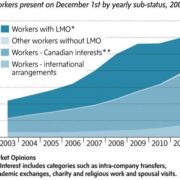
One of the most important things an employer must do before seeking employees outside Canada is to check whether they can hire a Canadian instead. According to Canada.ca, with some exceptions, employers are required to secure a Labour Market Impact Assessment (LMIA) before hiring a temporary foreign worker; an LMIA “verifies that there is a need for a temporary worker and that no Canadians are available to do the job.” The government also looks at applications for LMIAs to see whether an employer meets the following criteria:foreign workers stats - with and without LMOs

  • can fulfill all of the terms of the job offer;
  • [is] providing a good or a service in Canada or are applying for an in-home caregiver position; and
  • [is] offering employment that is consistent with the needs of the business.

Source: https://www.canada.ca/en/employment-social-development/services/foreign-workers/business-legitimacy.html

Unless a specific LMIA exemption code applies, the employer will need to apply and pay for an LMIA; this is NOT the employee’s responsibility.

A successful LMIA isn’t the end of the process either. The LMIA is the employer’s responsibility; in most cases, the potential employee needs to then get a work permit so they can be employed in Canada legally. Among other requirements, the applicant must be able to prove that they will be in Canada temporarily and will leave at the end of their work permit. The applicant will also need to show evidence that they are qualified to do the job they are being hired to perform. A temporary foreign work permit application will include gathering the necessary documents, such as proof of education or work experience, as well as a copy of the approved LMIA (if necessary) and the employment contract. Additional requirements, such as a medical examination and an Electronic Travel Authorization (eTA) or a visitor visa, will depend on your individual case.

What this Means for Temporary Foreign Workers

Workers should always be careful to look into the companies they apply to; with increased attention being paid to the issues with the temporary foreign worker program, making sure an employer has followed all the necessary steps and is legitimate takes on even greater importance. Knowing what is required can be confusing, but making sure that everything is done correctly is paramount. Working in Canada can open up a lot of opportunities, while an improperly done application (by the employer or potential employee) can close a lot of doors.

Do You Need Help?

Are you unsure of whether you can accept a job that’s been offered to you? Do you need assistance with your application for a work permit or an LMIA? Contact us so we can help you ensure the decisions you make today are the right ones for your career and your future.

preparing your Canadian CV

Preparing your Canadian CV

Writing Your Curriculum Vitae (CV) for the Canadian Market

Just as every job is different, the approach to getting hired can differ from country to country. Here are some tips on how to make your CV (curriculum vitae) appeal to Canadian employers, or in support of your work permit application or even immigration.

Canadian Resumes – Key Features

While every resume is different, here are some important elements to keep in mind:

  • Keep your CV short and focussed. While you don’t want to skip any relevant skills or experiences, Monster.com generally recommends limiting your resume to two pages (one if you’re a recent grad or otherwise less experienced).
  • Ensure that your resume is organized. You can create a chronological resume (organized based on when you gained specific experiences) or a functional resume (organized based on specific skills you gained). Either way, using headings, bulleted lists, bold or underlined text for key pieces of information, and other formatting elements can help make your CV easier to read.preparing your Canadian CV
  • Customize your resume for each job you apply for. While this can be time-consuming, tailoring your CV to the job you are applying for can make your application stand out. You can customize your resume by emphasizing relevant skills or cutting out experiences that don’t connect with the job you’re expressing interest in.
  • If you’re applying for a specific immigration program, you may also want to check if the job you’re applying for fits the criteria for the program in the first place. There are specific rules about which jobs are considered skilled trades or skilled workers, for example. Also, if the job does fit the criteria, keep those criteria in mind when writing the descriptions of your past work experience—just make sure that the duties and skills you mention in your description are accurate to the positions you’ve held.

Additional Information on your Resume

Depending on where you’re from and what the standards are for job applications there, what to include on your resume there may look a little different from a Canadian CV. Here are a few potentially unexpected features that may be worth including:

  • Your volunteer history—your experience is relevant and should be included in your CV whether it was paid or not. While unpaid work generally won’t count toward your work experience for an immigration application, it will for a job application.
  • Your social media—your Instagram, Twitter, LinkedIn or other social media accounts can be great places to build a professional brand and give potential employers a sense of your personality. This is especially true if you are in communications, marketing, or sales. Just remember to keep anything you’d prefer stayed personal set to private. If you want to make sure you are able to manage your social media professionally, you can create different accounts for your personal/social life and your career.

Details are Important to Potential Employers

Also, check for proper spelling, grammar and punctuation (you can use the free or paid version of the Google Chrome extension Grammarly to help with this). Not only will doing so make you look more professional, but it will help ease any concern on your potential employer’s part about language difficulties if English is your second language. To really set a potential employer’s mind at ease, do a little research to ensure that your CV is written using Canadian spelling and punctuation, which differs from American English in small but noticeable ways such as writing “colour,” not “color,” as well as from English outside North America (in Canada, it’s “realize,” not “realise,” for example).

While these details aren’t all directly related to your work experience, these subtle elements can provide clues to your potential employer as to whether you’ll be a good fit.

Getting your Foot in the Door

Do you need help applying for a work permit or your employer needs assistance to apply for an LMIA? As immigration professionals, we know the answers, and we can help you find the best path to Canada. Contact us if you have any questions.

digital security at canadian borders

Crossing Canada’s Border in the Digital Age

Getting Through Canadian Customs with Digital Devices

Visiting Canada requires that applicants subject themselves to intense scrutiny, from birth certificates and criminal records to the contents of travelers’ suitcases. Nowadays, temporary residents, like those on work permits, study permits and visitor visas, need to be careful that their digital self is admissible too.

According to the Globe and Mail, “The Canadian Border Services Agency (CBSA) only started tracking its searches last November. Between November 20 and March 4, CBSA “examined” the electronic devices of 4,529 travelers, a fraction of the 20,407,746 people who agents processed in that period.” So not everyone is searched, but anyone could be.

digital security at canadian borders

What to Do to Maintain your Privacy

Whether you’re coming here to work, study, or see the sights or your family abroad, you don’t want all the hard work that went into getting your application accepted to be for nothing. Often, the best way to ensure that your personal files aren’t misunderstood is to keep your private information private. The Globe and Mail suggests several ways to do so:

  • Travel with a “clean” device—that is, one that has the minimum personal data necessary for your trip and nothing else. Don’t bring extra files on a memory stick unless you need to.
  • Put your phone in airplane mode. This will still allow an officer to see files stored directly on your phone, but it will prevent ongoing access to your online information and keep the officer from being able to see your Cloud storage or linked devices.
  • Separate your personal and professional emails into different accounts. If you’re here for work, CBSA may want to see your work emails, but that doesn’t mean they need to read every email between you and your mom or what you buy online.
  • Be honest and ensure that there isn’t any confusion about the information you present at the border in the first place. You’re less likely to be searched if the things you say don’t raise red flags in the immigration officer’s mind.

What Not to Do

Don’t deny the officer the password to your device. While other passwords aren’t essential for them to know, denying access to your phone entirely will immediately set off alarm bells in an officer’s mind.

And don’t forget that just because you’re able to get into Canada once, coming back into the country after any trips away (if these are allowed within the terms of your visa or permit) will subject you to the same security checks.

Need Help?

Do you want to come to Canada to work, study or visit, but you aren’t sure what the next step is? We can help you determine your eligibility and put together an application; we’ll support you through all the steps required to get you through this process. Contact us for more info!