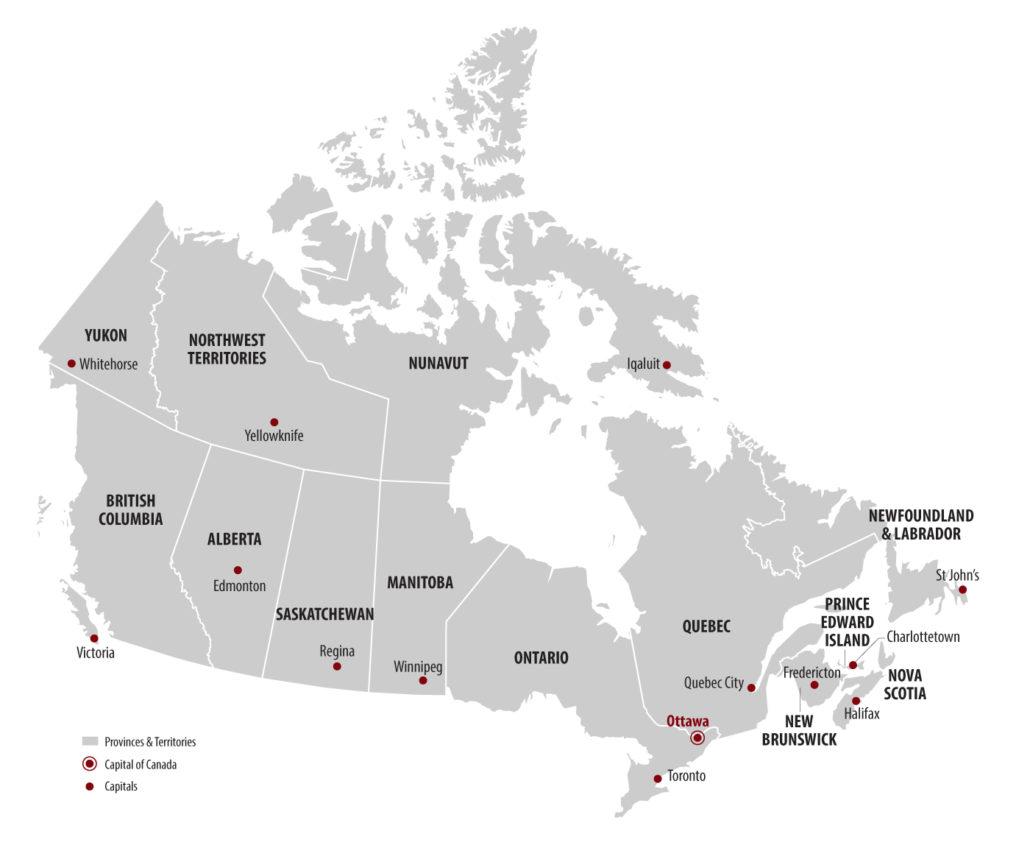
Which province do you want to immigrate to?

Canada is a federation composed of ten provinces and three territories, which may be grouped into regions: Western Canada, Central Canada, Atlantic Canada, and Northern Canada (the latter consists of the three territories Yukon, Northwest Territories, and Nunavut).

Provinces have more autonomy than territories and each has its own provincial or territorial symbols. The provinces are responsible for most of Canada’s social programs: health care, education, and welfare.

Provinces & Territories

www.hellobc.com – British Columbia
www.travelalberta.com – Alberta
www.sasktourism.com – Saskatchewan
www.gov.mb.ca – Manitoba
www.ontariotravel.net – Ontario
www.bonjourquebec.com – Quebec
www.tourismnewbrunswick.ca – New Brunswick
www.novascotia.com – Nova Scotia
www.tourismpei.com –Prince Edward Island
www.explorenewfoundlandandlabrador.com – Newfoundland and Labrador
www.nwt.worldweb.com – North-West Territories
www.nunavuttourism.com – Nunavut
www.travelyukon.com – Yukon Territory

language-for-immigration

I want to immigrate to Canada, do I need to know English? I want to study in Canada, do I still need to know English?

Planning to Immigrate to Canada?

One of the mandatory requirements under the Express Entry management system is the results of the language test, conducted by a designated language-testing agency approved by Immigration, Refugees and Citizenship Canada (IRCC). There are three IRCC-approved language test facilitators: CELPIP and IELTS for English, and TEF and TCF for French.

It has been established that knowledge of one of the official languages of Canada plays a major role in the economic and social success and integration of immigrants to Canada.

Therefore, IRCC has made it mandatory that applicants to most immigration categories meet the minimum language requirements.  Language tests are also mandatory for applicants whose native language is English or French, as the test score results are the only way to allocate language points to the applicant.  Your language test results must be less than two years old on the day they are received by IRCC.

Language Requirements for Different Immigration Programs

The language requirements are different depending on which immigration program you are applying for, as the language skills you’ll need will differ depending on whether you are hoping to immigrate to Canada as a skilled professional, a tradesman, as a business person, or through a provincial nominee program.

An applicant needs to achieve the required score in every ability: reading, writing, listening and speaking, as an overall score is not enough for immigration purposes. If an applicant lacks 0.5 of a point in one ability, then it means that the applicant is not eligible and thus needs to improve their language skills.

Should I Choose IELTS or CELPIP?

Your choice depends upon the availability of testing centers in your country.

IELTS has testing centers located in over 140 countries, while CELPIP has test centers at multiple locations across Canada, test sittings in Dubai, UAE, and New York, USA.  Please register as early as possible to avoid lengthy waiting times.

The Cost of Taking a Test

The fee may be about $300.00CAD per test; fees should be clarified with the specific test center where you intend to take the test.

Both facilitators offer free sample tests, upon completion of which you will be able to decide if you should register for a preparation course. The higher the score, the more points you will gain under the Comprehensive Ranking System under Express Entry. Because of this, you may find that you want to improve your language skills even if the practice tests show that you will probably pass.

English Language Test

CELPIP — Canadian English Language Proficiency Index Program — www.celpiptest.ca

You must take the “CELPIP-General” test to support your immigration application.

IELTS — International English Language Testing System —www.ielts.org

IELTS has test centers all over the globe.  You must take the “General Training” test.

French Language Test

TEF — Test d’évaluation de français  — www.francais.cci-paris-idf.fr

TEF is only available in French.

You must submit results from these TEF tests as proof of your French language skills:

  1. TCF Canada: Test de connaissance du français, including: https://www.ciep.fr/tcf-canada
  2. compréhension de l’écrit
  3. compréhension de l’oral
  4. expression écrite
  5. expression orale

Language Test for Students

Applicants planning to study in Canada are also required to meet the language requirements to successfully study at Canadian educational institutions.  Potential students from countries where English is not the primary language of instruction are required to provide an English language proficiency examination test result.  As a rule, tests must have been taken within the last 24 months at the time of the submission of your application.

A minimum overall band score of 6.5 is usually required for the academic (NOT general) IELTS test.  Some universities require an overall score of 7.0. Therefore, you will need to contact the educational institution of your choice in order to clarify the language requirements.

If you intend to study English or French as a Second Language, preliminary test results may not be required, as you will be required to take a test later to be placed in a group at your level.

Be prepared so that the best language test results can bring you closer to your dreams in Canada.

Avoid a Refusal

Often, we wonder why is it that we need professional help to do something we can do ourselves? I will simply follow the instruction manual and complete the task myself. After all, the instruction manual is provided for a reason.

While in most circumstances you can execute your own DIY project to desired results (while saving a few bucks), yet what if you were told that your future depended on it and you only get 1 chance to do it right? What would you do then? Consider the fact that the risk isn’t just about the effort or time you put into it, a negative outcome will lead to a financial loss along with a lost opportunity you only had one chance to grab.

Immigration Applications

Immigration applications are one such scenario. Yes, you do get an instruction guide and most of the times you may hit the nail on the head, but even a tiny error could result in extensive delays or in more critical scenarios – a long term ban.

As the saying goes, there’s more to it than meets the eye; similarly, in matters concerning immigration to Canada, many issues that an immigration officer may consider when making a decision aren’t addressed in the guide or checklist at all.

The fact that most people do not know is that an immigration officer would rather rely on guidelines set out in the Program Delivery Instructions, than the instruction guide available on the web.

Consider this – have you ever received or known someone who has received a visa refusal stating – ‘’lack of ties to country of origin’’, even when the applicant shared details of ownership of multiple properties, financial holdings, business undertakings of not just themselves but their entire families? Or how about – lack of employment prospects in their home country” despite them submitting official letters from their current employers stating that their positions will be held for them while they studied.

Mistakes Happen

The recent episode of the work permit refusal of Steve and Melanie Whitlow is proof enough that even the slightest error could open doors to significant delays, refusals and the painstaking immigration appeals process.

In a recent scenario, Steve and Melanie Whitlow, moved to B.C. from Wisconsin as part of B.C.’s PNP. While applying for an extension to their work permits, they failed to include the necessary Labour Market Impact Assessment (LMIA) exemption number from her employer. A small error, a mere oversight as she states. But it led to denial of their extension.

Such errors, although minor, yet unnoticeable to the untrained eye could be the make or break factor for your Canadian immigration application.

As a result, they lost half of their combined income because, the husband became ineligible to work in Canada legally. Although, the wife was able to appeal and get her permit re-instated, the husband’s case is still pending review. Thus, the cumulative stress and loss of income is far more than the RCIC’s professional fee.

These issues aren’t limited to study permits or work permits. Applicants are always at a disadvantage when dealing with Canadian Immigration on their own, because the power and knowledge are both in the hands of the government, and the officer reviewing an application has far less to gain or lose than the applicant. The immigration officer is part of the system that the applicant is trying to work with and therefore knows how to navigate the system, while the applicant is a newcomer to the maze of Immigration forms and lists.

Seek Representation

One way to help level the playing field is to seek representation. A regulated Canadian immigration consultant (RCIC) can provide legal knowledge and support through this difficult process, making dealing with Canadian Immigration less stressful and helping to improve the chances of success. With many years of experience, we know what to anticipate from Immigration officials, and we build your case based on its individual merits, going beyond the checklist provided by Immigration in order to successfully advocate on your behalf.

If you’re intending to come to Canada as a worker, a student or are planning to permanently immigrate to Canada and need help submitting an application, contact us.